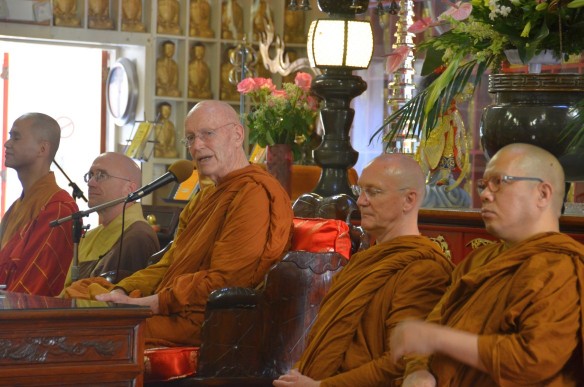
Venerable Ajahn Sumedho speaking at CTTB
On July 13, 2014, Venerable Ajahn Sumedho visited the City of Ten Thousand Buddhas to meet with the CTTB monastics and give a Dharma talk
[The talk was webcasted live and is available for viewing at this link.]. Ajahn Sumedho has been a Bhikshu for 47 years and has played a pivotal role in nurturing the Ajahn Chah Sangha of Western monastics.
In 2010, Ajahn Sumedho retired from his duties as the Abbot of Amaravati Monastery and leader of the Western Ajahn Chah Sangha. During the last few years of his retirement, he lived in Thailand living the simple life of a forest monk. So, it was a treasured occasion to able to attend a Dharma talk from such a Dharma Elder.
In the Buddha Hall, Ajahn Sumedho gave an hour Dharma Talk sharing his own personal journey practicing the Dharma.
In the Buddha Hall, Ajahn Sumedho gave an hour Dharma Talk sharing his own personal journey practicing the Dharma. He spoke about how he started as a young American living the free and hedonistic life in the 1960s but not finding any true happiness. After finishing his graduate studies at UC Berkeley, he went to Asia to pursue his interest in Eastern thought.
He wanted to go deeply into the Buddha’s teachings and put it into practice, so he went to Thailand and became a novice monk. He lived a simple life meditating in a hut where the only book he kept was on the Four Noble Truths. Read More …
Growing up as an ABC (American-Born Chinese) was quite challenging because I often had to navigate two different worlds. At school and with my American friends, I lived one existence. Back home, with my family, another.
I find that Asian and American value systems are often quite different, sometimes even in opposition.
I find that Asian and American value systems are often quite different, sometimes even in opposition. For instance, in America, independence and privacy–the right to do what I want without others interfering — is a fundamental right. In Chinese culture, the concept of a “right to privacy” is very new (articles in Economist and Statute Law Review). In traditional culture, the “individual unit,” if you will, is the family, and from this mindset, parents feel they have a parental duty to tell their children what is best. This becomes especially evident when it comes to major life decisions. In modern American society, parents clearly do not have a right to decide who their children can marry; for traditional Asian families, parents often expect veto power.
When I was in college, I wrote a paper on filiality and I asked a friend from Taiwan who was studying Physics with me about his relationship with his dad. Read More …
“The capacity of the mind is vast and far-reaching; like empty space, it has no boundaries. It is neither square nor round, large nor small. Nor is it blue, yellow, red, or white. It has no above or below, no long or short. Moreover, it has no anger or joy, right or wrong, good or evil, beginning or end.”
— From the chapter on Prajna from the Sixth Patriarch Sutra
Notes Taken From Doug Powers’s lecture series, “Buddhism for the Modern Mind”, 9/30/13
This generation has the greatest amount of social freedom—more than any generation in the past. But this generation hasn’t yet figured out how to use this freedom for real liberation. Identities of gender, culture, religion, economics, etc. have opened up since the 1960s, but people don’t yet know what to make of this tremendous amount of freedom—In fact, they may even be afraid of it. People don’t seem to have a confidence and comfort in freedom from limited identities; instead they avoid a sense of possibility and immerse themselves in distractions.
Here is a place where the Buddha meets the contemporary mind, with the goal of finding the greatest amount of real freedom. But what is freedom? How do we free ourselves? What does freedom feel like?
Read More …
UKIAH, California, February 3, 2014 — Dharma Realm Buddhist University (DRBU) today announced that the Senior College and University Commission of the Western Association of Schools and Colleges (WASC) has granted DRBU eligibility to proceed with an application for WASC Candidacy and Initial Accreditation—a significant progress in the University’s pursuit of regional accreditation.
In its letter, the Commission expressed appreciation for the “preparation DRBU undertook in its application which exhibited depth of consideration and care” as well as the “clear articulation of [DRBU’s] philosophy blending the East and West in a broad liberal arts-based education growing out of Buddhism.” Further, the Commission stated that DRBU’s “strong program with solid academics, a qualified administration, faculty, and staff” and thorough understanding of the accreditation process are evidence of the University’s “potential to achieve accreditation and to show further growth.” The Commission also provided feedback on DRBU’s Eligibility application and highlighted important areas that require additional attention as DRBU works toward WASC Candidacy, which it has “until Fall 2017 to achieve.” Read More …
父母呼,應勿緩,父母命,行勿懶。
父母教,須敬聽,父母責,須順承。
When my parents call me, answer immediately.
When they give instructions, carry them out, don’t drag my feet.
When they give advice, listen respectfully.
When they scold me, accept it with gratitude.
– Standard for Students [Note: translation is a bit different than the one provided by the link —I think filiality looks different in 21st century America than it did 2000 years ago in China, but the spirit is the same.]
[This is the seventh in a series of posts reflecting on how I found myself drawn to monasticism despite (or perhaps because of) my upbringing in the Bay Area and providing insight into how the relatively secular environment in which I grew up prompted me to look deeper into the meaning of life.]
Probably the biggest change I made in myself in relation to my parents was based on the first two verses in the section on filiality in Standard for Students.
Namely, when my parents called for me, I did my best to respond immediately. Read More …
… perhaps during those impending college years that I was so looking forward to, I would decide “what to be when I grow up.”
When I was a kid, I naturally had different—and significantly simpler—assumptions about how the world operates than I do today. Based on my upbringing and education, I had the impression that at some point in my life, perhaps during those impending college years that I was so looking forward to, I would decide “what to be when I grow up.” Logically this decision would take into account things like enjoyment, aptitude, and economic factors. There were a few options that I was considering, mostly involving technology—maybe engineering or aerospace—but whatever my choice, I was confident that my grown-up life would be a great success.
In hindsight, perhaps I was just a bit overconfident. But I was certainly determined, and over the years I’ve found that determination counts for a lot. When my grandfather—a man of few words—dropped me off at college, he told me, “work hard.” So I did. I chose my path, and years later found myself with a Bachelor’s degree in Music (see enjoyment, above) and Physics (aptitude), working in an administrative position at Apple Computer (economic factors). And as my grandmother used to tell me, “you’ve made your bed, and now you have to lie in it.” So I did that too. Live and learn. Read More …
[This is the sixth in a series of posts reflecting on how I found myself drawn to monasticism despite (or perhaps because of) my upbringing in the Bay Area and providing insight into how the relatively secular environment in which I grew up prompted me to look deeper into the meaning of life.]
弟子規,聖人訓。首孝悌,次謹信
泛愛眾,而親仁。有餘力,則學文。
The sages have left these standards for being a student.
You first begin with filial respect and then learn to be careful and trustworthy.
Be kind and caring to all and stay near good people.
With any time left, you should devote it to study.
–Standards for Students
To be honest, I never thought about what it meant to be a “good son” until I became interested in Buddhism and the monastic life. It was an unexpected teaching that really sank in when I became a sophomore in college.
In hindsight, I was a typical callow youth, with an attitude of putting myself first and my parents second. I remember one story from when I was in pre-school. My mom gave me a chocolate bar and then asked me if I would share some of it with her. Reluctantly, I broke the chocolate bar in half, planning on giving her the smaller piece. To my dismay, I saw that they were both the same size, so what did I do next? I took a bite out of one half and then sheepishly offered it to her. Talk about filiality! Read More …
Although these figures may use different words to express their ideals and look after separate communities, they all share one thing in common. They do not live for themselves.
In the eight months that I have spent in India so far this year, I have encountered a number of modern day gurus. I stumbled across the Karmapa’s Kagyu Monlam in Bodhgaya, served others alongside Swami Asimatmananda in Chapra, felt the warmth of Amma’s embrace in Delhi, and watched the transformation of Maharaj Yadneshwara in Beed. Although these figures may use different words to express their ideals and look after separate communities, they all share one thing in common. They do not live for themselves. The lives of the Karmapa, Asimatmananda, Amma, and Yadneshwara are dedicated to serving living beings and helping them to fully develop their humanity. Toward this end, each of them supports an educational institution: the Karmapa International Buddhist Institute, Ramakrishna Mission’s school for poor children, Amma’s Amrita University, and Yajneshwara’s traditional Vedic gurukula.
In December, his Holiness the Karmapa led the Kagyu Monlam in Bodhgaya, where he taught about Bodhisattva Samantabadra’s prayer for excellent conduct. The event brought together people from all over the world who strengthened their resolve for awakening. After a couple from Germany guided me to the prayer site, Lamas came around with hot butter tea and steamed bread to make sure all the guests were comfortable. The ancient Mahābodi Temple came alive with color, lights, and hospitality. The merit generated from this practice is thought to pacify disasters and remove obstacles not only for those to take part in the Monlam, but for all living beings. Read More …

 SHARE
SHARE EMAIL
EMAIL COMMENT0 comments